Destroy a Vault Pro Tips
Last updated 2026-10-11
Advanced guide
Use a configuration that matches your current base: a deployed Common with Damage/Battery for the first Cash cycle; a funded robot replacement; or a keeper with a priced mutation and a four-matching fusion plan. The values below support those specific decisions, rather than a universal robot DPS tier.
Three named progression configurations
| Configuration | Prerequisite | Robot/upgrades | Resource decision |
|---|---|---|---|
| Crossfire Cash starter | A claimed Common, bought placement slot and working Smelter loop | Recorded Crossfire 1,300 Cash; Robot Damage, then Battery if charging interrupts attacks | Keep the next placement/purchase funds; Luck and extra offers follow stable income |
| Funded Uncommon replacement | You can buy and place the displayed offer | Recorded Reactor Warden 180,000 Cash; compare its live DPS with the exact Common it replaces | An unplaced purchase or a weaker replacement does not improve the army |
| Keeper plus mutation/fusion | A robot you will retain; Gems for its Core; island two and four matching non-fused inputs for fusion | Recorded late examples Iron Bark 1.9 billion Cash and Cryotitan 13 billion; Damage/Battery remain relevant | Iron for the four-core Gem-efficiency goal; Lightning for their largest listed single-slot multiplier; save a matching fusion set |
These are conditional named builds based on the recorded roles and prices. They do not assert that Crossfire beats every Common or that Cryotitan beats every upgraded/mutated Mythic. Compare the collected robot records.
A budget for the named starter and its next boards
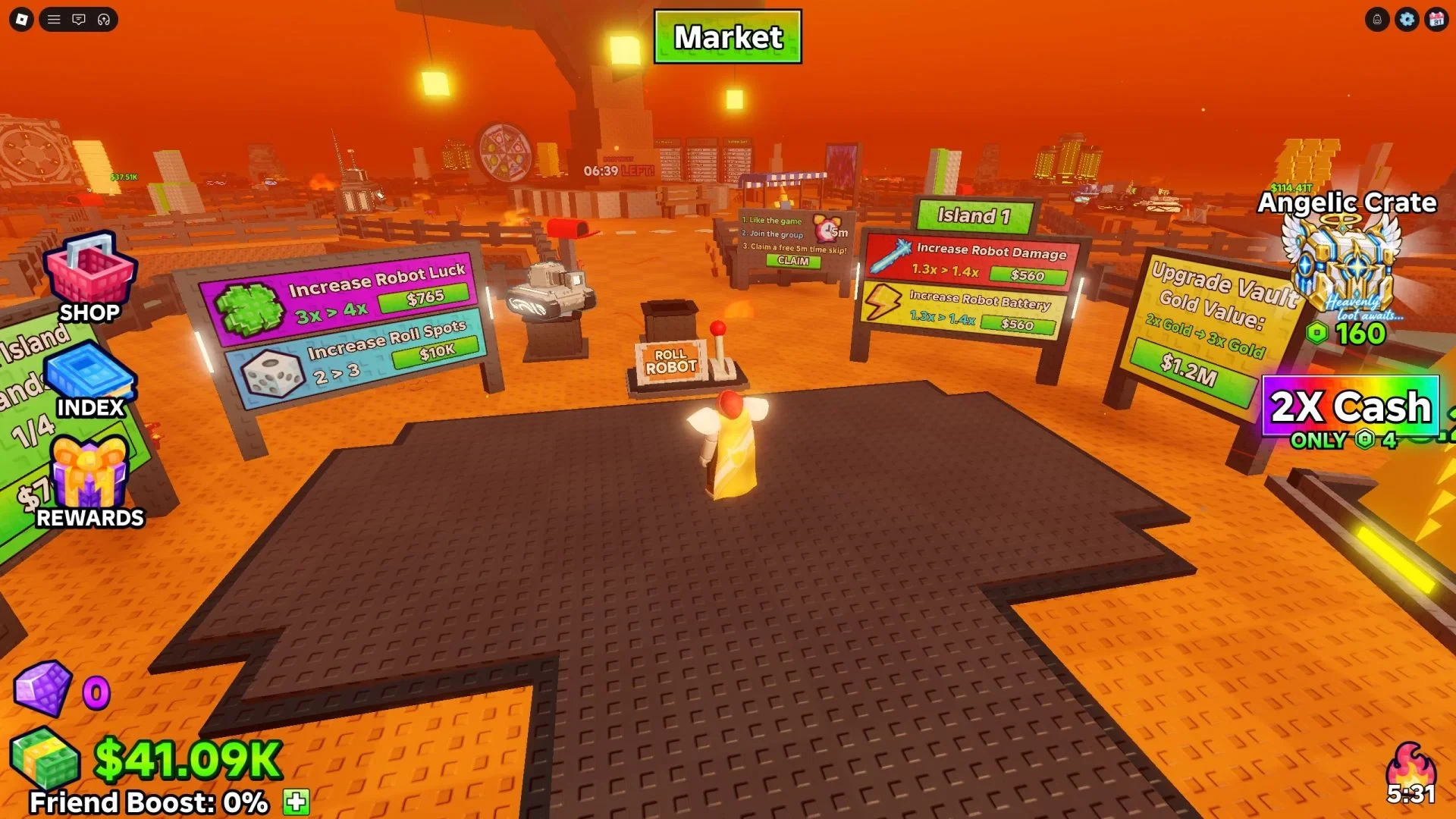
At the states shown in the October 5 upgrade-board screenshot, read October 11, Damage 1.3× → 1.4× costs 560 Cash and Battery 1.3× → 1.4× costs 560. With a Common already deployed, 1,120 Cash covers those two steps. Add the pictured Luck 3× → 4× step at 765 only when future purchases are funded: the three-step budget totals 1,885 Cash.
Using the recorded 1,300-Cash Crossfire purchase, Crossfire plus those two attack-side steps totals 2,420 Cash before placement and individual upgrades. The three-board version totals 3,185 Cash before those other costs. The budget combines dated source examples; use each amount when your offer/board matches the stated price and level. An already placed Ironclad or Phantom can use the same 1,120-Cash board budget. The recorded 64,000-Cash Rampage plus those two steps totals 65,120 before placement and individual upgrades.
At the pictured later states, Roll Spots 2 → 3 costs 10,000 Cash and Gold Value 2× → 3× costs 1,200,000. The first adds one concurrent offer; the second raises the displayed Gold multiplier by 50%. Choose the offer for a funded collection search, or use the 1.2-million-price payback example for a payout investment after efficient clears. Read all five step comparisons.
Choose the optimal next action for the visible bottleneck
- Empty or blocked deployment: place the robot you already own; buy a base slot or replace a weaker member.
- Steady attacks with little health loss: inspect Robot Damage and individual robot levels.
- Repeated charging pauses: inspect Robot Battery so the army spends more time attacking.
- A stable army but weak offers: improve Robot Luck while preserving the Cash needed to buy the next result.
- Funded collection search: add Roll Spots for simultaneous offers and keep missing Index entries.
- Fast clears but modest payouts: compare Vault Gold Value or the next vault using Cash per complete cycle.
Superlex fills fighting slots, then finds the Damage and Battery boards while his first vault is slow. The sequence around 4:06 demonstrates why buying another offer does not solve a charging pause. Use the board priority conditions.
Gem-efficient damage versus maximum output from one slot
| Core | Recorded Gem price | DPS multiplier | Added base DPS per 1,000 Gems | Choice on the same unmutated robot |
|---|---|---|---|---|
| Iron | 5,000 | 1.5× | 0.1× | Most added base DPS per Gem among these four |
| Flame | 25,000 | 1.75× | 0.03× | More output per slot than Iron; five times its Gem price |
| Frost | 150,000 | 2× | 0.00667× | An intermediate output choice when Lightning is unaffordable |
| Lightning | 400,000 | 2.25× | 0.003125× | Largest single-slot multiplier among these four |
AlphaShoe’s October 4 shop at 11:47, read October 11, displays Iron’s 5,000-Gem price and 1.5× multiplier. The October 5 Bloxodes shop image, inspected October 11, gives the other three Gem prices/multipliers. Compare the same unmutated base robot and level; the recorded Gems are examples, not a live shop check.
Iron is the most Gem-efficient of these four: added base DPS per Gem is 0.5/5,000, compared with Flame’s 0.75/25,000. Iron’s ratio is about 3.33 times Flame’s. Lightning gives the highest single-slot output among these four, 2.25× the same base. Keep this four-option comparison separate from other cores elsewhere in the Market reference; it does not establish stacking or the largest modifier in the whole game.
The Robux alternatives differ between the dated views. The Bloxodes image shows Iron 25, Flame 45, Frost 60 and Lightning 70 Robux; AlphaShoe’s shop shows Iron 54, Flame 93 and Frost 133. Those are different recorded shop states, not interchangeable current prices. Gem budgets above keep the currency separate.
A named team and ranking you can reproduce
For the two already-owned early Level 1 Ironclad and Crossfire cards, the recording shows 67 and 40 displayed DPS. At explicitly stated 100% attacking uptime with owned slots, choose Ironclad for one slot (67 DPS), or Ironclad + Crossfire for two (107 DPS). Load the recorded pair and then enter the actual levels, uptime and costs for your own Cobra, Phantom, Rampage or other attackers. The returned lineup ranks and names the candidates that fit your entered Cash/slots; it does not fill missing stats for you.
A separate late JONA Level 1 pair shows Cataclysm 687.5M DPS and Aetherforge 275M. At the same stated 100% uptime, one slot selects Cataclysm; two total 962.5M. Both are from the same late army segment with a visible weather timer. Do not combine these values with the early Alpha cards as a normalized whole-game tier. Read the card times and conditions.
Keep the right duplicates and distinguish purchases
After island two, keep four non-fused robots of the same type for fusion. Four Ironclads satisfy the matching-name condition; Ironclad + Cobra + Phantom + Rampage do not. A fused robot cannot be fused again in the described system. The beginner walkthrough says newly collected robot entries build Index Luck, so a missing Common entry can still help collection even after you replace it in the fighting army.
Roll Spots gives concurrent podium offers, while placement slots hold attackers. AlphaShoe buys multiple roll positions to search the Index and buys fighting slots separately. If a purchased robot is waiting in your hands, another roll position will not equip it.
His early 2.7-billion Mythic offer is unaffordable at that point; later he buys Iron Bark at 1.9 billion and Cryotitan at 13 billion after income grows. Superlex’s early island prompt is 700,000 Cash, while AlphaShoe’s next expansion after fusion is 60 million. Preserve the particular purchase and progression position when using these recorded numbers.
A concrete army with different robot levels
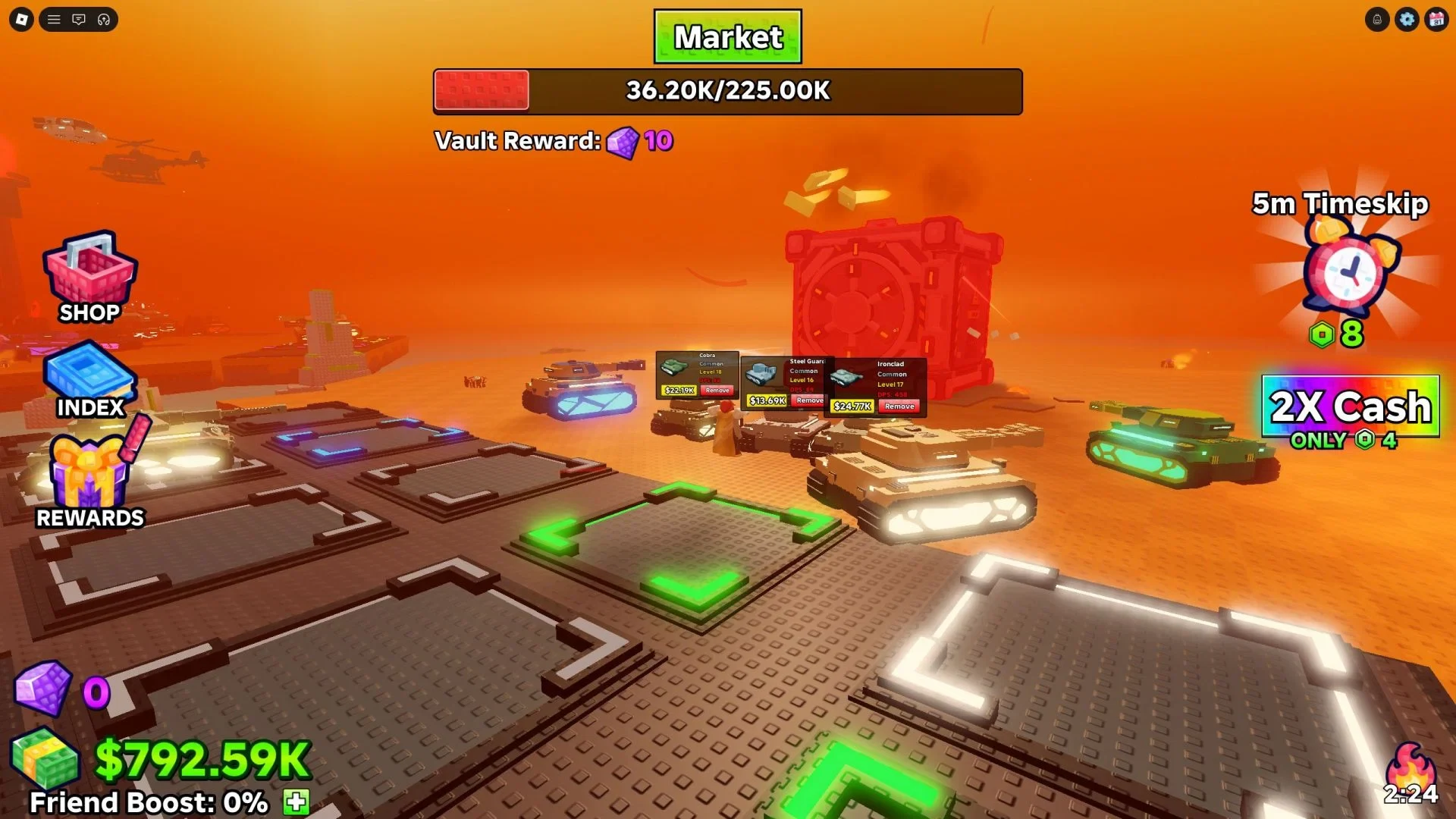
The vault-attack image in the October 5 guide, read October 11, shows Cobra Common at Level 18, Steel Guard Common at Level 16 and Ironclad Common at Level 17. This adds a real named deployed-army example to the progression configurations. A fair replacement comparison keeps each robot’s actual level and mutation in view; those different-level cards cannot establish a universal best Ironclad or Cobra team. Read the three collected card records.
What follows the recorded Mythic purchases?
AlphaShoe identifies Divine after Mythic in the Index around 18:39, passes a 19-billion-Cash offer, and later buys a 23-billion offer around 25:35 before calling it his first Divine. That is a concrete save-then-purchase progression example; the later podium view names Fallout Divine at 23 billion and Talon Gate Divine at 27 billion. Those named recorded offers give useful Cash targets without supplying a normalized whole-roster DPS ranking.
JONA G.’s October 6 noob-to-master video visibly states “full team of 40 Omnipotent tanks” near 17:24 while showing the deployed army. Use Omnipotent as a reported later collection goal, while keeping the actual robot names, compared DPS and purchase prompts separate from that description. The existing keeper/fusion steps still provide the funded path; this source adds a later target with the separately scoped named DPS pairs above.
Upgrade payback and community advice
Compare smelted Cash per complete-cycle second before and after a purchase, keeping the army and boosts unchanged. An upgrade’s Cash payback is its cost divided by the positive increase in Cash per second. Use the worked comparison; the currency guide keeps Gold, Cash, Gems and Robux separate.
For your entered army, the comparison tool returns an actual named rank and affordable team using the displayed DPS, levels and uptime you supply. The recorded pairs and same-base Core table also give concrete conditional choices. A complete current-roster universal tier is a different result and is not supplied by these examples. The advice is attributed to the linked gameplay and walkthrough; a matching original Reddit pro-tips thread was not obtained.
For the opening actions use the first robot-to-Cash sequence; use Index and collection systems for your next missing entry.
Compare your actual robot levels, uptime and fighting-slot lineup →
Sources (32)
- LoopForge Studios Roblox description — checked 2026-10-08
- AlphaShoe — Mythic robot progression (caption observations) — checked 2026-10-08
- Bloxodes beginner guide, October 5, 2026 — checked 2026-10-08
- Bloxodes upgrade boards image accompanying October 5 guide — checked 2026-10-11
- JONA G. October 6 video description (reported late-game run) — checked 2026-10-11
- Bloxodes unnamed vault reward image accompanying October 5 guide — checked 2026-10-11
- AlphaShoe recorded game UI at 294.503343s — checked 2026-10-11
- AlphaShoe recorded game UI at 374.25334s — checked 2026-10-11
- AlphaShoe recorded game UI at 429.303339s — checked 2026-10-11
- AlphaShoe recorded game UI at 792.33667s — checked 2026-10-11
- AlphaShoe recorded game UI at 791.336668s — checked 2026-10-11
- AlphaShoe recorded game UI at 986.336668s — checked 2026-10-11
- AlphaShoe recorded game UI at 1656.336668s — checked 2026-10-11
- AlphaShoe recorded game UI at 1705.336664s — checked 2026-10-11
- AlphaShoe recorded game UI at 1121.336668s — checked 2026-10-11
- AlphaShoe recorded game UI at 255.0s — checked 2026-10-11
- AlphaShoe recorded game UI at 1658.336667s — checked 2026-10-11
- AlphaShoe recorded game UI at 1708.336667s — checked 2026-10-11
- AlphaShoe recorded game UI at 1776.336668s — checked 2026-10-11
- AlphaShoe recorded game UI at 105.0s — checked 2026-10-11
- AlphaShoe recorded game UI at 130.0s — checked 2026-10-11
- AlphaShoe recorded game UI at 290.0s — checked 2026-10-11
- AlphaShoe recorded game UI at 412.782s — checked 2026-10-11
- AlphaShoe recorded game UI at 1393.248s — checked 2026-10-11
- JONA G. recorded game UI at 1044.561892s — checked 2026-10-11
- JONA G. recorded game UI at 959.561892s — checked 2026-10-11
- JONA G. recorded game UI at 972.561891s — checked 2026-10-11
- JONA G. recorded game UI at 977.561891s — checked 2026-10-11
- JONA G. recorded game UI at 497.322s — checked 2026-10-11
- AlphaShoe Cobra Level1 card at0:32 — checked 2026-10-11
- AlphaShoe Phantom Level 1 card at 281.429122s — checked 2026-10-11
- AlphaShoe Rampage and Ironclad Level 1 cards at 329.429121s — checked 2026-10-11